

Our practice in Denver specializes in advanced oral surgical techniques to preserve your oral health and prepare for future restorations. Socket preservation protects the bone that supports your smile after a tooth is removed, keeping your jaw’s natural shape and the foundation you may need for a future dental implant.
Under the care of oral surgeon Dr. John Nesiba, treatment is planned around your anatomy, your goals, and a calm, precise surgical experience.

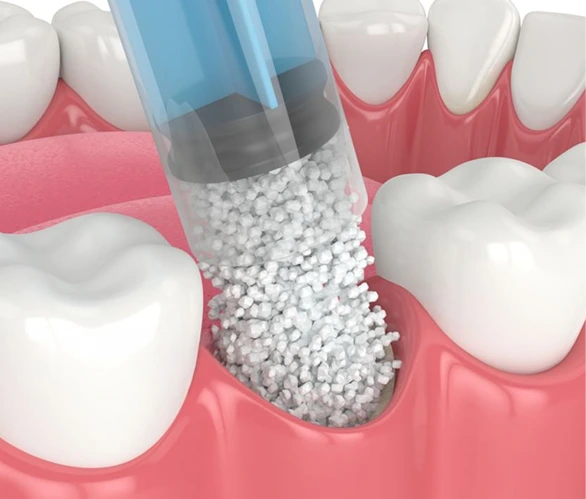
Socket preservation, also known as alveolar ridge preservation, is a regenerative procedure performed at the time of tooth removal. After a tooth leaves the jaw, the empty socket can collapse as the body remodels the area – the ridge becomes narrower and shorter, gum contours flatten, and future restorations like dental implants become more difficult. Bone grafting material is placed into the socket immediately after extraction so the site holds its height and width while new, healthy bone fills in.
Your visit is designed to be as comfortable and efficient as possible. Socket preservation is frequently completed in the same appointment as the extraction, so you do not have to return later to fill a socket that has already begun to shrink.
Dr. Nesiba reviews your medical and dental history, discusses your overall health, and examines the tooth, surrounding tissues, and oral cavity. Imaging – X-rays or a 3-D CBCT scan – may be used to assess the socket, nearby roots, the sinus, the nerve in the lower jaw, and the condition of your jawbone. You leave with a clear treatment plan that outlines how extraction and grafting will be sequenced, comfort options, and what healing typically looks like.
The tooth is removed with care to protect the bony walls of the socket, then the empty socket is thoroughly cleaned. Dr. Nesiba places biocompatible bone grafting material into the space; a membrane may be used to hold the graft in position, and the gum is gently closed with sutures. Local anesthesia keeps you comfortable throughout; sedation options are available, and a responsible adult should be present if sedation is used.
Many patients are surprised by how brief the grafting portion feels once the tooth is out. You receive written aftercare instructions before you leave
Mild soreness, swelling, a sense of fullness, and discomfort are common in the first few days and can be managed with prescribed medication or over-the-counter pain relievers. You will receive detailed instructions on pain management, diet, oral hygiene, and activity restrictions. Healing typically takes several months as grafting material is gradually replaced by your own natural bone.

You may be a strong candidate if you are having a tooth removed and want to keep implant options open, maintain your gumline and facial structure, or avoid losing jawbone that will not grow back on its own.
Socket preservation is not required after every extraction – some sockets with thick bony walls heal with acceptable volume on their own – and Dr. Nesiba will explain whether it is the most useful step for your anatomy and goals.
Ideal candidates are in reasonably good general health, can follow aftercare instructions, and have healthy gums and an adequate blood supply around the socket.
The most meaningful benefit is protecting bone while it is still there, which often means less extensive grafting later and a more predictable path to a replacement tooth.
Prevents jawbone shrinkage and maintains the height, width, and density needed for stable restorations.
Facilitates dental implant placement with a solid foundation, simpler surgery, and a higher success rate.t
Preserves facial aesthetics by helping avoid a sunken look in the cheeks and lips and maintaining the natural shape of your jaw and gum line
Improves stability for other restorations, including bridges, dentures, temporary flippers, and partials, so neighboring teeth have adequate support and prosthetics fit more comfortably.
The cost of socket preservation in Denver typically ranges from $400 to $800 per socket and may reach $1,200 per site. Price varies based on the complexity of the extraction, the type of bone grafting material, whether a membrane is used, anatomy, the number of sockets treated, additional procedures, and your overall surgical plan.
Insurance benefits differ by policy; our team can review coverage and discuss financing, including CareCredit, PatientFi, and Alphaeon Credit.
Our surgical practice is built around precise oral surgery and thoughtful implant planning – socket preservation is part of how our team prepares the jaw for what comes next, not an afterthought.